
The landscape of YouTube content creation is rapidly transforming, with AI-powered text-to-video tools at the forefront of this revolution. In 2026, these platforms are not just generating videos; they are automating entire workflows, allowing creators to scale their channels like never before. Choosing the right tool can significantly impact your efficiency, content quality, and ultimately, your channel’s growth. We’ve analyzed the leading platforms based on their stock media availability, voiceover capabilities, avatar realism, and automation features to provide a definitive ranking for YouTube automation.
Ranking the Top Text-to-Video AI Tools for YouTube Automation in 2026
InVideo AI: Best Overall for Stock Library and Ease of Use
For creators prioritizing speed, variety, and a streamlined workflow, InVideo AI stands out as the premier choice. Its most significant advantage is its massive stock library, boasting over 16 million videos and images. This extensive collection ensures that your AI-generated videos have visual diversity, preventing the repetitive look that can plague channels relying on smaller asset pools. The platform’s core strength lies in its intuitive process: a single text prompt can generate an entire video, complete with visuals, voiceover, and music. This makes it exceptionally well-suited for rapid YouTube automation, enabling creators to produce content at an unprecedented pace. With a global user base exceeding 7 million creators, InVideo AI has proven its effectiveness in helping individuals and businesses scale their video output. The video output quality is consistently high, supporting up to 1080p HD, ensuring a professional appearance for your YouTube channel.
Pictory: Top Choice for Repurposing Long-Form Content
Pictory has carved a unique niche by specializing in the transformation of existing long-form content into engaging short videos perfect for YouTube. If you already have a backlog of blog posts, articles, or even podcast transcripts, Pictory is your ideal tool for automating a faceless YouTube channel by repurposing that content, which is a growing trend in faceless AI content. Its standout feature is the AI-powered ‘auto-highlight’ function, which intelligently identifies the most compelling sentences and key moments within your text, automatically creating video segments around them. This intelligent summarization and video generation process saves immense time and effort. Pictory integrates with Getty Images, granting access to millions of professional stock assets to enrich your videos. Its script-to-video and article-to-video workflows are highly optimized, making it a powerful asset for creators looking to maximize the value of their existing content library and streamline their YouTube presence.
Fliki: Unmatched for Voiceover and Language Options
When it comes to audio, Fliki is the undisputed leader, offering an unparalleled selection of voiceover and language options. Its platform boasts over 2000 AI voices, the most extensive collection available on the market, catering to virtually any tone or style you require. This makes Fliki the go-to solution for channels targeting international audiences or those needing highly specific, nuanced voice performances. With support for over 75 languages, Fliki breaks down language barriers, enabling global reach. Beyond its voice capabilities, Fliki integrates powerful automation tools. Features like RSS feed to video and bulk creation allow for truly hands-off content generation, perfect for niche channels or those focused on rapid output from external content sources. This combination of superior audio and robust automation makes Fliki a compelling option for creators prioritizing voice diversity and international appeal.
Synthesia & HeyGen: Leaders in Realistic AI Avatars
For creators who envision a human-like presenter guiding their audience, Synthesia and HeyGen represent the pinnacle of AI avatar technology in 2026. These platforms are ideal for corporate training videos, educational channels, explainer content, or any format where a relatable, AI-powered presenter can build credibility and trust. Synthesia is particularly geared towards enterprise users, offering 140+ diverse AI presenters and supporting over 120 languages with remarkably accurate lip-syncing. It has been adopted by over 50,000 companies, including many Fortune 500 organizations. HeyGen, while also offering a professional edge, provides advanced features like voice cloning, allowing you to replicate your own voice or create custom AI voices for your avatars, a key aspect of AI voice cloning for faceless videos. Both platforms are renowned for their broadcast-quality, near-human avatar realism, ensuring your AI-generated videos look polished and professional. If your YouTube strategy hinges on a consistent on-screen personality, these tools offer the most convincing solutions.
How Do Key Automation Features Compare Across Platforms?
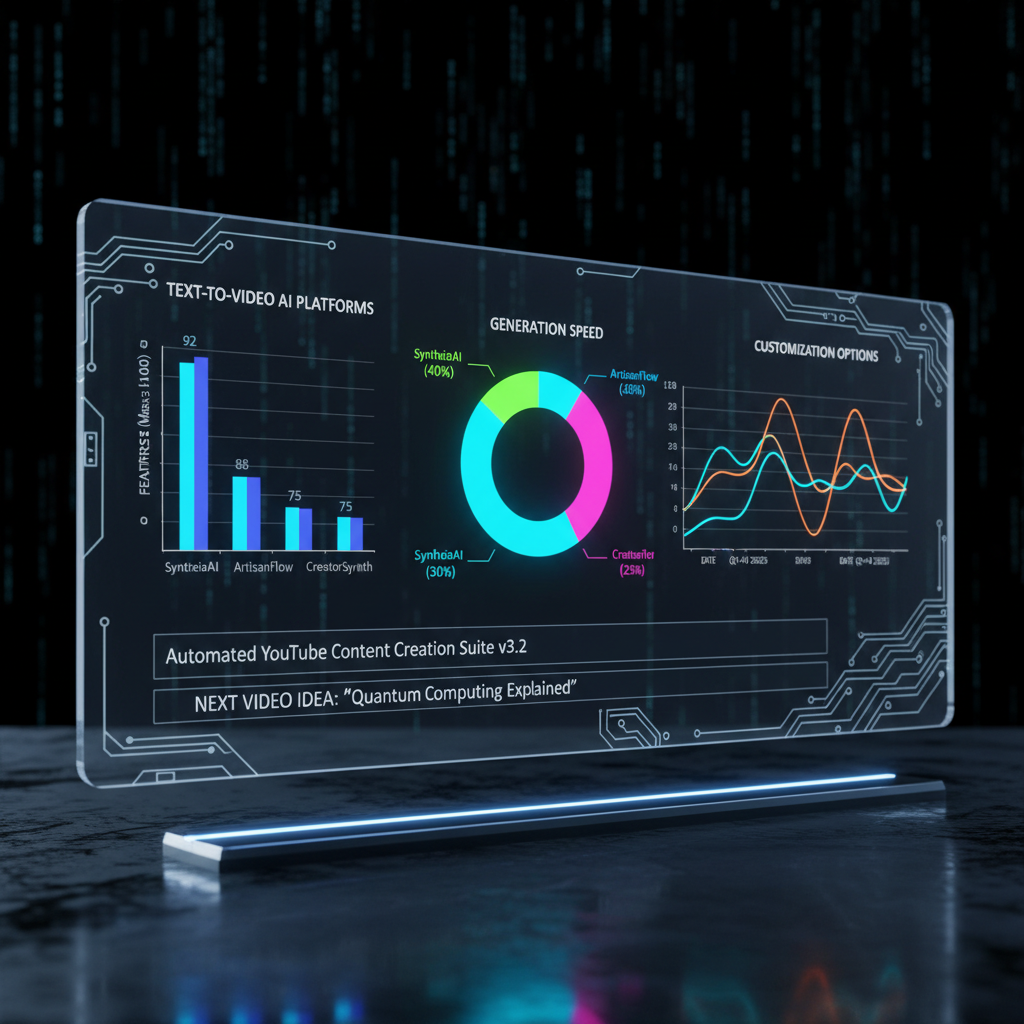
The effectiveness of text-to-video AI for YouTube automation hinges on a combination of features, each serving different creator needs. While raw video quality is steadily improving across the board, the true differentiators lie in the nuances of AI voice generation, the breadth of stock media libraries, and the sophistication of the automation workflows, including advanced AI script generation for YouTube. Understanding these distinctions is crucial for selecting the platform that best aligns with your content strategy and production goals for 2026.
Feature Deep Dive: AI Voice Quality vs. Stock Media Variety
Choosing between a tool strong in AI voiceovers and one rich in stock media often presents a core decision for YouTube automation. InVideo AI shines with its 16M+ stock assets, providing unparalleled visual variety, though its standard AI voices are competent rather than groundbreaking. Conversely, Fliki leads the pack with 2000+ AI voices across 75+ languages, offering exceptional vocal diversity, complemented by a solid, though less extensive, premium stock library. Pictory offers integration with Getty Images, providing access to millions of assets and also allows for custom voice uploads, giving creators flexibility. Synthesia stands out with its 120+ languages featuring precise lip-sync for its avatars, alongside custom background options and stock media integration, making it a robust all-rounder for professional presentations.
Workflow Automation: From Single Prompts to Bulk Creation
The concept of automation varies significantly between platforms. InVideo AI champions a ‘one-and-done’ approach, where a single text prompt can generate a complete video, ideal for quickly turning ideas into content. Fliki takes a different path, enabling bulk video creation from scripts or even RSS feeds, which is perfect for automated content pipelines. Pictory excels at automating the process of extracting key highlights from longer text-based content, streamlining repurposing efforts. For more advanced integration, Synthesia and HeyGen provide API access, allowing programmatic video generation for large-scale or dynamic content needs. The “best” automation is therefore not a single feature, but a workflow that matches your specific content creation strategy, whether that’s rapid idea generation, content repurposing, or large-scale batch production.
Cost vs. Output: Analyzing the ROI of AI Video Tools in 2026
The financial justification for using text-to-video AI tools is compelling. Research indicates that these platforms can reduce video production costs by 70-80% compared to traditional methods, as noted by McKinsey Digital in 2024. Furthermore, the Creator Economy Report (2024) highlights that AI tools can slash production time by 40-60%. This significant time saving translates directly into cost efficiency and increased output. Examining the pricing, tools like InVideo AI start around $25/month, Pictory at $23/month, and Synthesia at $29/month. These monthly fees are a modest investment when weighed against the substantial savings in both time and resources, making AI video generation a highly attractive proposition for scaling YouTube channels in 2026.
What Are the 2026 YouTube Policies on AI-Generated Video?

As AI technology becomes more integrated into content creation, understanding platform policies is crucial for creators. YouTube, as the dominant video platform, has established guidelines regarding AI-generated content to ensure transparency and maintain a trusted environment for its viewers. Navigating these policies correctly is essential for monetization and compliance.
Understanding YouTube’s AI Content Disclosure Requirements
In 2024, YouTube introduced updated policies requiring creators to disclose when their content is significantly altered or synthetically generated using AI, particularly when it depicts realistic people or situations. This policy is primarily about transparency; it aims to inform viewers when they are watching content that is not entirely real or has been manipulated. For creators using text-to-video AI tools like Synthesia or HeyGen to generate realistic avatars, or tools that significantly alter footage, disclosure is often mandatory. Failing to label such content, especially when it could be misleading, can lead to policy violations. Adhering to these disclosure requirements is vital for maintaining good standing on the platform and fostering trust with your audience.
Can You Monetize an AI-Automated YouTube Channel?
The short answer is yes, AI-generated content is eligible for monetization through the YouTube Partner Program (YPP). The key is that the content must still adhere to all of YouTube’s standard YPP policies, which prohibit spam, deceptive practices, and content that violates copyright or community guidelines. The mere use of AI in the creation process does not disqualify a channel. To be eligible for monetization, channels must meet the standard YPP requirements: accumulating at least 1000 subscribers and 4000 valid public watch hours within the past 12 months. The remarkable 300% increase in AI video content on YouTube observed between 2023 and 2024 demonstrates that AI-driven channels are not only viable but also a growing and monetizable path for creators. The focus remains on the value and adherence to guidelines, regardless of the production method.
Before committing to a text-to-video AI tool in 2026, consider this: the choice often depends more on your specific content workflow than on raw video quality, which is becoming uniformly high across leading platforms. The way a tool integrates with your creation process—whether it’s prompt-first generation, long-form repurposing, or bulk automation—will have the most significant impact on your scalability. As a clear action step, I recommend testing the free tier of InVideo AI to experience its prompt-first workflow and the free tier of Pictory to see how it handles one of your existing articles. Your preference between these distinct approaches will likely become clear within minutes, guiding your decision.