
The barrier to entry for content creation has shattered. Imagine generating a complete, publishable piece of content in under 30 minutes – that’s the reality AI brings to creators in 2026. This tutorial guides you through a proven 7-step workflow, demystifying the process for beginners. With 73% of marketers already leveraging AI, you’re joining a massive wave of innovation that’s making content creation faster, more efficient, and surprisingly accessible, especially when considering building a 2026 faceless content strategy for brands.
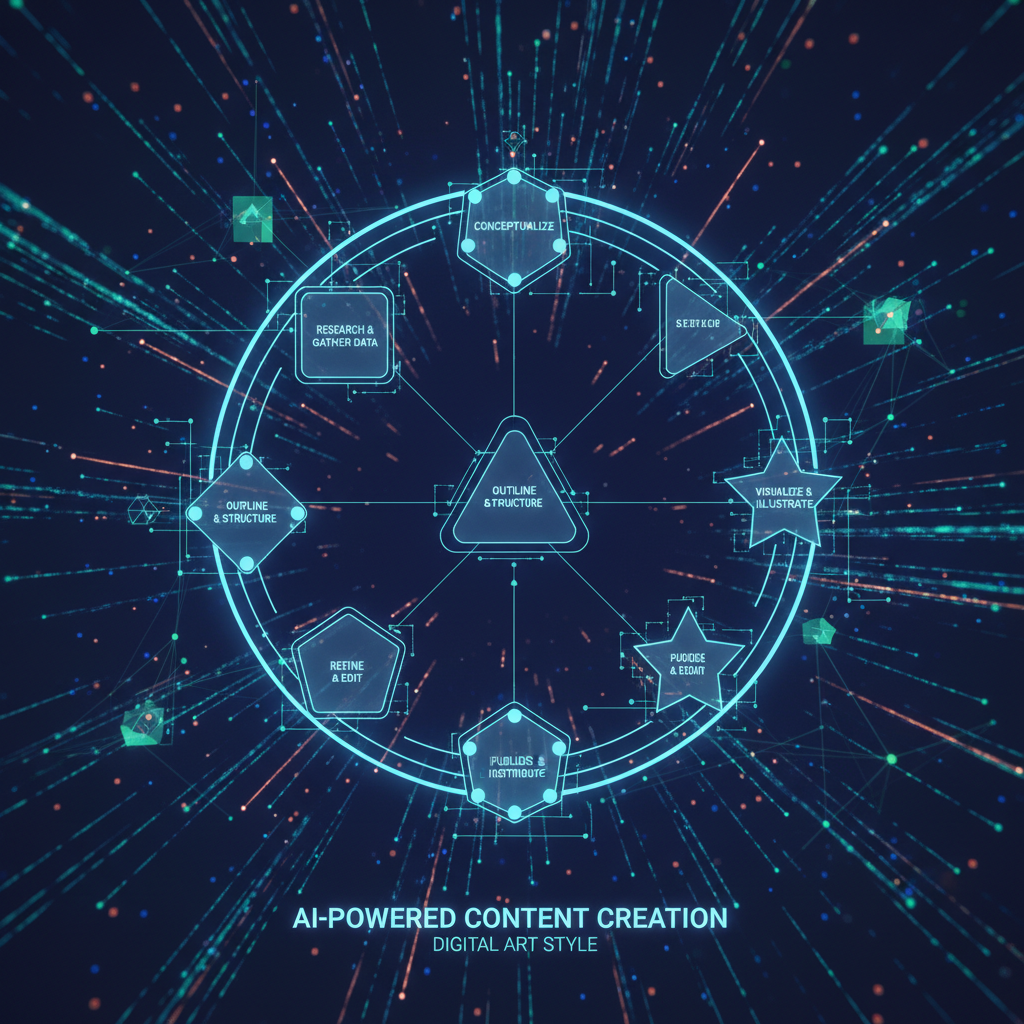
- The core AI content workflow has 7 steps: Goal Setting, Tool Selection, Prompting, Generation, Humanizing, Visuals, and Publishing.
- According to a 2023 McKinsey Digital Report, AI can reduce content creation time by 50-70%.
- The 2026 best practice for quality is a 60% AI generation to 40% human refinement ratio, as recommended by the Content Marketing Institute.
- Data from Jasper AI shows that 82% of new users can create publishable content within their first week.
The 7-Step AI-Powered Content Creation Workflow for 2026

Steps 1 & 2: Define Goals and Choose Your 2026 AI Tool Stack
The foundational step in any content creation process, AI-powered or not, is defining your objective. What do you want this piece of content to achieve? Are you aiming to educate, entertain, or drive conversions? Your goal dictates the content type and, crucially, the AI tools best suited for the task. For beginners, focusing on a manageable stack is key. The most accessible tools offer free tiers or affordable starting plans, making them ideal for experimentation. Matching the right tool to your content goal ensures efficiency and quality from the outset. For instance, generating a compelling blog post intro requires a different approach than crafting a series of social media captions. The Semrush Content Report of 2024 indicates that blog posts are the most common content type (78%), followed by social media (65%) and email marketing (54%), highlighting the diverse applications of AI in content creation.
| Tool | Best For | 2024 Pricing |
|---|---|---|
| ChatGPT (OpenAI) | Versatile text generation, idea brainstorming, outlines, drafting | Free tier available; Plus: $20/month |
| Jasper AI (Creator Plan) | Marketing copy, blog posts, social media content, brand voice | Starts at $49/month |
| Canva AI (Magic Write) | Short-form text, social media captions, presentation content, visual integration | Free tier available; Pro: $13/month |
Steps 3 & 4: Master Basic Prompts to Generate Your First Draft
Prompt engineering, the art of crafting effective instructions for AI, is the engine of AI-powered content creation. For beginners, mastering a few core principles can dramatically improve output quality. The goal is to be clear, specific, and provide sufficient context. Aim for prompts between 50-200 words for optimal results, as this range often yields the most comprehensive and relevant responses from advanced models like GPT-4. Remember, AI tools such as ChatGPT and Jasper AI are designed to interpret natural language, but the more precise your instructions, the better the outcome.
- Be Specific: Clearly state the topic, desired format (e.g., blog post intro, social media caption), target audience, and tone of voice.
- Provide Context: Include relevant background information, keywords, or key points you want the AI to incorporate.
- Define the Output: Specify the length, structure, and any specific elements you need (e.g., “include a call to action,” “write in a friendly tone”).
- Iterate: Don’t expect perfection on the first try. Refine your prompts based on the AI’s output until you achieve satisfactory results.
Sample Starter Prompt for a Blog Post Intro:
“Write an engaging introductory paragraph for a blog post titled ‘Your First AI-Powered Content Creation Tutorial: Video from Scratch in 30 Mins’. The target audience is beginners with no prior experience in AI content tools. The tone should be encouraging and informative, highlighting how quickly a complete piece of content can be produced. Mention that this tutorial covers a 7-step workflow and reference the high adoption rate of AI by marketers.”
Steps 5 & 6: Humanize and Optimize Your AI-Generated Content
While AI excels at generating text rapidly, the crucial step for ensuring quality, authenticity, and engagement is human refinement. The Content Marketing Institute recommends a 60% AI generation to 40% human refinement ratio for optimal results in 2026. This means AI should handle the heavy lifting of drafting, but human oversight is essential for adding nuance, personality, and ensuring factual accuracy. Expect to spend approximately 15-30 minutes editing every 1,000 words of AI-generated text. Tools like Grammarly can assist in polishing grammar, style, and clarity, but the core task of infusing a unique voice and perspective remains human. This human touch transforms generic AI output into compelling content that resonates with your audience. It’s this blend of AI efficiency and human creativity that defines high-quality content in the modern digital landscape, a key aspect of effective faceless AI content strategies.
Step 7: Add AI-Generated Visuals and Complete Your Tutorial
To create a truly publishable piece of content, visuals are indispensable. Fortunately, AI is making significant inroads into visual content creation as well. Tools like Canva AI (with Magic Media), Midjourney, and DALL-E 3 can generate unique images based on text prompts, allowing you to create custom graphics that perfectly complement your written content. Simply describe the visual you envision, and these AI tools can bring it to life. For example, if your tutorial discusses the efficiency gains of AI, you might prompt an AI image generator to create a visual representing speed or productivity. Integrating these AI-generated visuals, alongside your human-edited text, completes the workflow. You’ve now gone from a raw idea to a polished, visually appealing, and ready-to-publish piece of content, all within a remarkably short timeframe.
What’s Driving the AI Content Creation Boom in 2026?

Market Growth: A $2.5B Market Projected to Hit $6.5B by 2030
The AI content creation landscape is experiencing unprecedented growth, transforming how businesses and individuals approach digital communication. The market, valued at a robust $2.5 billion in 2023, is on a trajectory to reach an astounding $6.5 billion by 2030, according to projections from Grand View Research in 2023. This significant expansion isn’t just abstract financial data; it reflects a fundamental shift in content strategy across industries. The HubSpot State of Marketing Report of 2024 underscores this by revealing that a staggering 73% of marketers now utilize AI tools in their content creation processes. This widespread adoption signals a clear industry consensus: AI is no longer a futuristic concept but a present-day necessity for staying competitive and efficient in the digital realm. This boom is fueled by the demand for scalable, high-quality content across numerous platforms, from blogs to social media, making tools that facilitate this process highly sought after.
Proven Efficiency Gains: Slashing Creation Time by up to 70%
One of the most compelling drivers behind the AI content creation boom is the dramatic increase in efficiency it offers. The ability to produce content at a significantly faster pace is a game-changer for creators and businesses alike. A McKinsey Digital Report from 2023 highlighted that AI tools can reduce content creation time by an average of 50-70%. This isn’t a marginal improvement; it’s a fundamental enhancement of productivity. Furthermore, the McKinsey Global Institute reported in 2023 that businesses leveraging AI can achieve average cost savings of up to 62% on their content initiatives. The impact is immediate and tangible: HubSpot data from 2024 shows that 67% of users report faster content creation with AI assistance. This leap in speed and cost-effectiveness allows creators to focus more on strategy, creativity, and audience engagement rather than getting bogged down in the repetitive aspects of content production, a core benefit for those exploring AI content automation.
- Time Savings: AI tools reduce content creation time by 50-70% on average (McKinsey Digital Report, 2023).
- Cost Savings: Businesses can achieve average cost savings of up to 62% by integrating AI into their workflows (McKinsey Global Institute, 2023).
- Speed & Output: 67% of users report faster content creation with AI (HubSpot, 2024).
The Beginner’s Advantage: 82% Create Publishable Content in Week 1
Perhaps the most encouraging aspect of AI content creation is its accessibility for beginners. Contrary to the notion that sophisticated AI tools require extensive technical expertise, recent data suggests otherwise. Internal data from Jasper AI indicates that a remarkable 82% of new users can successfully create publishable content within their first week of using the platform. This statistic is crucial because it lowers the barrier to entry significantly, empowering individuals, small businesses, and solo entrepreneurs to produce high-quality content without needing large teams or specialized skills. Moreover, the Content Marketing Institute found in 2024 that 65% of content creators report an improvement in their content quality when using AI assistance. This combination of rapid learning curves and enhanced output quality makes AI an indispensable tool for anyone looking to establish or scale their online presence, whether through traditional methods or innovative faceless content strategies.
The most surprising finding is that 82% of beginners can create publishable content within their first week using AI tools, effectively removing the intimidation factor often associated with new technology, and enabling the creation of anonymous content with AI. Pick one tool from our table, sign up for its free trial, and use our sample prompt to generate your first paragraph right now.
- The core AI content workflow has 7 steps: Goal Setting, Tool Selection, Prompting, Generation, Humanizing, Visuals, and Publishing.
- According to a 2023 McKinsey Digital Report, AI can reduce content creation time by 50-70%.
- The 2026 best practice for quality is a 60% AI generation to 40% human refinement ratio, as recommended by the Content Marketing Institute.
- Data from Jasper AI shows that 82% of new users can create publishable content within their first week.
The 7-Step AI-Powered Content Creation Workflow for 2026
Steps 1 & 2: Define Goals and Choose Your 2026 AI Tool Stack
The foundational step in any content creation process, AI-powered or not, is defining your objective. What do you want this piece of content to achieve? Are you aiming to educate, entertain, or drive conversions? Your goal dictates the content type and, crucially, the AI tools best suited for the task. For beginners, focusing on a manageable stack is key. The most accessible tools offer free tiers or affordable starting plans, making them ideal for experimentation, and you can explore the 7 best AI tools for content creation to find your perfect fit. Matching the right tool to your content goal ensures efficiency and quality from the outset. For instance, generating a compelling blog post intro requires a different approach than crafting a series of social media captions. The Semrush Content Report of 2024 indicates that blog posts are the most common content type (78%), followed by social media (65%) and email marketing (54%), highlighting the diverse applications of AI in content creation.
| Tool | Best For | 2024 Pricing |
|---|---|---|
| ChatGPT (OpenAI) | Versatile text generation, idea brainstorming, outlines, drafting | Free tier available; Plus: $20/month |
| Jasper AI (Creator Plan) | Marketing copy, blog posts, social media content, brand voice | Starts at $49/month |
| Canva AI (Magic Write) | Short-form text, social media captions, presentation content, visual integration | Free tier available; Pro: $13/month |
Steps 3 & 4: Master Basic Prompts to Generate Your First Draft
Prompt engineering, the art of crafting effective instructions for AI, is the engine of AI-powered content creation. For beginners, mastering a few core principles can dramatically improve output quality. The goal is to be clear, specific, and provide sufficient context. Aim for prompts between 50-200 words for optimal results, as this range often yields the most comprehensive and relevant responses from advanced models like GPT-4. Remember, AI tools such as ChatGPT and Jasper AI are designed to interpret natural language, but the more precise your instructions, the better the outcome.
- Be Specific: Clearly state the topic, desired format (e.g., blog post intro, social media caption), target audience, and tone of voice.
- Provide Context: Include relevant background information, keywords, or key points you want the AI to incorporate.
- Define the Output: Specify the length, structure, and any specific elements you need (e.g., “include a call to action,” “write in a friendly tone”).
- Iterate: Don’t expect perfection on the first try. Refine your prompts based on the AI’s output until you achieve satisfactory results.
Sample Starter Prompt for a Blog Post Intro:
“Write an engaging introductory paragraph for a blog post titled ‘Your First AI-Powered Content Creation Tutorial: Video from Scratch in 30 Mins’. The target audience is beginners with no prior experience in AI content tools. The tone should be encouraging and informative, highlighting how quickly a complete piece of content can be produced. Mention that this tutorial covers a 7-step workflow and reference the high adoption rate of AI by marketers.”
Steps 5 & 6: Humanize and Optimize Your AI-Generated Content
While AI excels at generating text rapidly, the crucial step for ensuring quality, authenticity, and engagement is human refinement. The Content Marketing Institute recommends a 60% AI generation to 40% human refinement ratio for optimal results in 2026. This means AI should handle the heavy lifting of drafting, but human oversight is essential for adding nuance, personality, and ensuring factual accuracy. Expect to spend approximately 15-30 minutes editing every 1,000 words of AI-generated text. Tools like Grammarly can assist in polishing grammar, style, and clarity, but the core task of infusing a unique voice and perspective remains human. This human touch transforms generic AI output into compelling content that resonates with your audience. It’s this blend of AI efficiency and human creativity that defines high-quality content in the modern digital landscape, a key aspect of effective Faceless AI Content strategies.
Step 7: Add AI-Generated Visuals and Complete Your Tutorial
To create a truly publishable piece of content, visuals are indispensable. Fortunately, AI is making significant inroads into visual content creation as well. Tools like Canva AI (with Magic Media), Midjourney, and DALL-E 3 can generate unique images based on text prompts, allowing you to create custom graphics that perfectly complement your written content. Simply describe the visual you envision, and these AI tools can bring it to life. For example, if your tutorial discusses the efficiency gains of AI, you might prompt an AI image generator to create a visual representing speed or productivity. Integrating these AI-generated visuals, alongside your human-edited text, completes the workflow. You’ve now gone from a raw idea to a polished, visually appealing, and ready-to-publish piece of content, all within a remarkably short timeframe.
What’s Driving the AI Content Creation Boom in 2026?
Market Growth: A $2.5B Market Projected to Hit $6.5B by 2030
The AI content creation landscape is experiencing unprecedented growth, transforming how businesses and individuals approach digital communication. The market, valued at a robust $2.5 billion in 2023, is on a trajectory to reach an astounding $6.5 billion by 2030, according to projections from Grand View Research in 2023. This significant expansion isn’t just abstract financial data; it reflects a fundamental shift in content strategy across industries. The HubSpot State of Marketing Report of 2024 underscores this by revealing that a staggering 73% of marketers now utilize AI tools in their content creation processes. This widespread adoption signals a clear industry consensus: AI is no longer a futuristic concept but a present-day necessity for staying competitive and efficient in the digital realm. This boom is fueled by the demand for scalable, high-quality content across numerous platforms, from blogs to social media, making tools that facilitate this process highly sought after.
Proven Efficiency Gains: Slashing Creation Time by up to 70%
One of the most compelling drivers behind the AI content creation boom is the dramatic increase in efficiency it offers. The ability to produce content at a significantly faster pace is a game-changer for creators and businesses alike. A McKinsey Digital Report from 2023 highlighted that AI tools can reduce content creation time by an average of 50-70%. This isn’t a marginal improvement; it’s a fundamental enhancement of productivity. Furthermore, the McKinsey Global Institute reported in 2023 that businesses leveraging AI can achieve average cost savings of up to 62% on their content initiatives. The impact is immediate and tangible: HubSpot data from 2024 shows that 67% of users report faster content creation with AI assistance. This leap in speed and cost-effectiveness allows creators to focus more on strategy, creativity, and audience engagement rather than getting bogged down in the repetitive aspects of content production, a core benefit for those exploring AI content automation.
- Time Savings: AI tools reduce content creation time by 50-70% on average (McKinsey Digital Report, 2023).
- Cost Savings: Businesses can achieve average cost savings of up to 62% by integrating AI into their workflows (McKinsey Global Institute, 2023).
- Speed & Output: 67% of users report faster content creation with AI (HubSpot, 2024).
The Beginner’s Advantage: 82% Create Publishable Content in Week 1
Perhaps the most encouraging aspect of AI content creation is its accessibility for beginners. Contrary to the notion that sophisticated AI tools require extensive technical expertise, recent data suggests otherwise. Internal data from Jasper AI indicates that a remarkable 82% of new users can successfully create publishable content within their first week of using the platform. This statistic is crucial because it lowers the barrier to entry significantly, empowering individuals, small businesses, and solo entrepreneurs to produce high-quality content without needing large teams or specialized skills, especially when exploring what is faceless AI content. Moreover, the Content Marketing Institute found in 2024 that 65% of content creators report an improvement in their content quality when using AI assistance. This combination of rapid learning curves and enhanced output quality makes AI an indispensable tool for anyone looking to establish or scale their online presence, whether through traditional methods or innovative faceless content strategies.
The most surprising finding is that 82% of beginners can create publishable content within their first week using AI tools, effectively removing the intimidation factor often associated with new technology, and enabling the creation of anonymous content with AI. Pick one tool from our table, sign up for its free trial, and use our sample prompt to generate your first paragraph right now.